Define heavy-metal requirements by destination, product category, intended use and buyer specification before quotation. Specify each analyte, limit, unit, method and reporting limit; distinguish total from speciated results and representative reports from actual-lot evidence. Assess finished-product exposure separately where required.
Start with the destination and intended use
Heavy metals testing is one part of qualifying psyllium husk or psyllium husk powder. A useful report must answer a specific question: does the identified material meet the agreed requirements for the intended application? A four-element panel or a generic statement of compliance is not enough on its own.
Before requesting a quotation, identify the destination country, whether the material is for food, supplements, pharmaceutical use or feed, and the buyer's finished-product requirements. Do not transfer a limit between these categories without checking its applicability.
Which elements should the specification cover?
| Element | What to specify |
|---|---|
| Lead (Pb) | Maximum concentration, reporting units and the agreed acceptance basis. |
| Cadmium (Cd) | A separate result and limit rather than a combined heavy-metals value. |
| Arsenic (As) | Whether the requirement concerns total arsenic or inorganic arsenic. These are different measurements. |
| Mercury (Hg) | Whether total mercury is sufficient or a particular chemical form is required. |
These four elements are a practical starting point for a buyer discussion, not a universally sufficient or legally mandatory panel for every psyllium application. Add other elements where the applicable standard or risk assessment requires them.
Agree the applicable limits before testing
Separate three things in the specification: the applicable legal requirement, any contractual buyer limit, and any finished-product exposure assessment. Record the source and version used for each requirement. A buyer may request a tighter purchasing limit, but a commercial agreement cannot replace an applicable legal requirement.
For EU food uses, the European Commission identifies Regulation (EU) 2023/915 as the framework for maximum levels of certain contaminants in specified foods. This does not establish one blanket psyllium limit. Confirm the relevant food category, current amendments and treatment of the ingredient before selecting a limit. European Commission reference.
Choose a suitable method and reporting limit
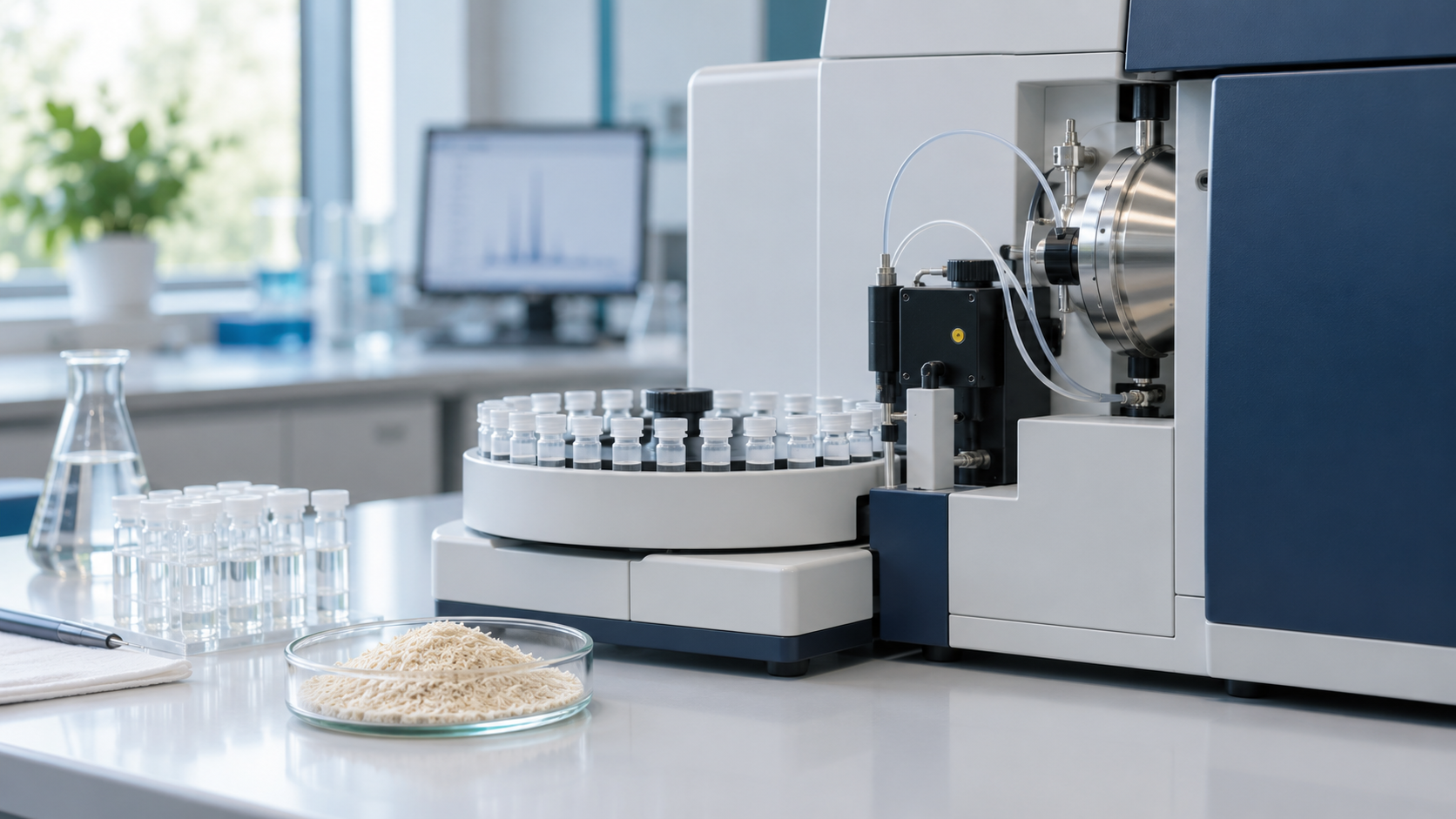
ICP-MS is an analytical option for measuring multiple elements. FDA EAM section 4.7, version 1.3 (April 2025), describes microwave-assisted digestion followed by ICP-MS for total acid-extractable elemental concentrations in food. A total-element result does not identify individual chemical species. Ask the laboratory to confirm suitability for the psyllium matrix, required analytes and target concentrations; citing an FDA method is not FDA approval of a product. FDA method reference.
Request the method reference, units and limit of quantification (LOQ) for each element. “Not detected” does not mean zero. For example, a report of less than 0.50 mg/kg cannot establish compliance with a buyer limit of 0.20 mg/kg. These figures illustrate report interpretation only; they are not recommended limits. If results are close to a limit, ask the laboratory to explain the applicable decision rule and measurement uncertainty.
Understand units and exposure
For mass-based concentrations, 1 mg/kg equals 1 ppm and 1 microgram/g; 1 microgram/kg equals 1 ppb. Compare values only when the units and reporting basis match. Confirm whether results are reported as received or on a dry-weight basis.
For an illustrative intake calculation, concentration in mg/kg multiplied by ingredient intake in grams/day gives micrograms/day. Thus, 0.10 mg/kg multiplied by 5 g/day contributes 0.50 micrograms/day from that ingredient. This is arithmetic, not a safety determination or acceptance limit; a finished formulation may have additional sources of the same element.
California Proposition 65 needs a separate assessment
OEHHA publishes exposure-based safe-harbor levels, expressed in micrograms/day, for listed chemicals. These should not be treated as a universal raw-ingredient concentration specification. Assess the relevant chemical, exposure route, intended use and finished-product exposure before making a warning determination. A raw-material COA alone does not justify an unqualified “passes Prop 65” claim. OEHHA reference.
Match the evidence to the commercial lot
A historical or representative report can help assess a proposed supplier. It does not establish the result for a different sales lot. Where commercial-lot testing is required, agree the sampling plan, sample identification, lot coverage and release process before dispatch.
- Match the product form, supplier, lot number and sample description to the proposed supply.
- Check sampling, receipt, testing and report dates, plus the report number and issuing laboratory.
- Review each numerical result, method, unit and reporting limit against the signed specification.
- Request the relevant laboratory accreditation scope where accredited testing is required.
- Resolve missing or ambiguous evidence before accepting the lot; document any investigation of an out-of-specification result.
What to include in your RFQ
- Whole husk or powder, purity, mesh where applicable, quantity and destination.
- Intended application and finished-product category.
- Each analyte, required chemical form, maximum value, units and reporting basis.
- Method or performance requirements, reporting limits and laboratory requirements.
- Representative evidence needed before quotation and actual-lot evidence needed before release.
- Testing frequency, sampling responsibility, sample quantity and report delivery deadline.
- Testing charges, payment responsibility, turnaround time and handling of a nonconforming lot.
Ask for separate confirmation of material price and additional testing costs. Do not assume that every optional test is included in the quoted ingredient price.
Discuss your requirement with Systler
Share your buyer specification, destination, application and required quantity so the proposed source and testing scope can be reviewed. Availability, analytical results, testing costs and delivery timing require confirmation for the proposed supply. This guide is not a batch COA, a product certification or a guarantee that every lot meets every market's requirements.
Key takeaways
- Agree the applicable legal and buyer requirements before quotation.
- Specify lead, cadmium, arsenic and mercury individually where required; define chemical forms and any additional analytes.
- Check units, reporting basis and LOQ; “not detected” does not mean zero.
- Representative reports do not certify a different commercial lot.
- Proposition 65 involves exposure assessment, not a universal raw-material ppm limit.
- Confirm sampling, testing charges, turnaround and release criteria in the RFQ.
References & sources
- FDA EAM 4.7: ICP-MS elemental analysis of food, version 1.3 — U.S. Food and Drug Administration · View source
- Food contaminants legislation and maximum-level framework — European Commission — Directorate-General for Health and Food Safety · View source
- Proposition 65 safe-harbor levels: NSRLs and MADLs — California Office of Environmental Health Hazard Assessment (OEHHA) · View source