Assess moisture, total ash, acid-insoluble ash, commercial purity and swelling together using agreed methods and reporting bases. Define the destination and application first, compare like-for-like results, and verify the commercial lot. A purity percentage or swelling result alone does not establish safety or overall compliance.
Read the parameters together
Moisture, ash, commercial purity and swelling volume answer different questions about psyllium husk and psyllium husk powder. A purchase decision should combine them with identity, particle size, safety requirements and performance in the intended formulation. A single attractive result does not establish that a lot is suitable.
What each parameter tells a buyer
| Parameter | What it describes | What to confirm |
|---|---|---|
| Moisture | Water content assessed by the specified procedure. | Method, maximum value and reporting basis. |
| Total ash | Inorganic residue remaining after incineration. | Maximum value and whether it is expressed on a dry basis. |
| Acid-insoluble ash | The portion of ash remaining after the specified acid treatment. | A separate limit and method; do not substitute total ash. |
| Commercial purity | The supplier's defined measure of husk content or separation from other material. | Definition, sampling and test procedure behind the percentage. |
| Swelling volume | Volume occupied after hydration under defined test conditions. | Minimum value, units and the complete hydration procedure. |
An Indian reference for psyllium husk
The psyllium section on printed page 76 of the cited FSSAI 2022 document lists the following criteria. They are a reference within that document's scope, not a universal export specification or a statement of results for Systler material.
| Characteristic | Cited criterion |
|---|---|
| Moisture | Maximum 11.5% by mass |
| Total ash | Maximum 4.0% by mass, dry basis |
| Acid-insoluble ash | Maximum 0.45% by mass, dry basis |
| Swelling volume | Minimum 40 mL/g |
| Organic extraneous matter | Maximum 2% by mass |
Read the FSSAI source. Confirm the currently applicable provisions, product category and destination requirements before adopting these figures contractually. A buyer may request tighter limits; an agreed specification cannot waive an applicable legal requirement. The extraneous-matter criterion should not be converted into an assumed commercial “98% purity” grade.
Moisture: specify the method, not just a number
Moisture matters when assessing storage, handling and consistency. Ask which analytical procedure was used: a loss-on-drying result and a water-specific determination should not be assumed interchangeable. Also confirm whether other reported results are calculated on an as-received or dry basis.
A moisture result alone does not prove shelf life, packaging suitability or microbiological safety. Agree storage conditions and packaging protection separately, and assess commercial-lot evidence against the complete specification.
Ash: distinguish two measurements
Total ash includes inorganic material naturally present in the botanical as well as any extraneous inorganic residue captured by the method. Acid-insoluble ash provides a different measurement and can help assess acid-insoluble mineral material. Neither is a stand-alone proof of adulteration or a substitute for identifying the cause of an unusual result.
Check the calculation basis before comparing suppliers. For illustration, 3.8% total ash as received at 10% moisture corresponds to approximately 4.22% on a dry basis: 3.8 × 100 ÷ 90. Comparing the uncorrected 3.8% directly with a dry-basis limit could lead to the wrong decision. Ask the laboratory to confirm the appropriate calculation and method.
Purity: define what 95%, 98% or 99% means
Treat commercial purity descriptions as specifications that need an agreed definition. Ask what is measured, which material is counted as an impurity, how a sample is prepared and how the result is calculated. Do not equate a commercial purity percentage with dietary fibre content, pharmaceutical grade or overall regulatory compliance.
Compare grades using the same definition and method. A higher stated purity cannot compensate for an unsuitable particle size, an unacceptable contaminant result or inadequate performance in the buyer's application.
Swelling volume: compare like-for-like results
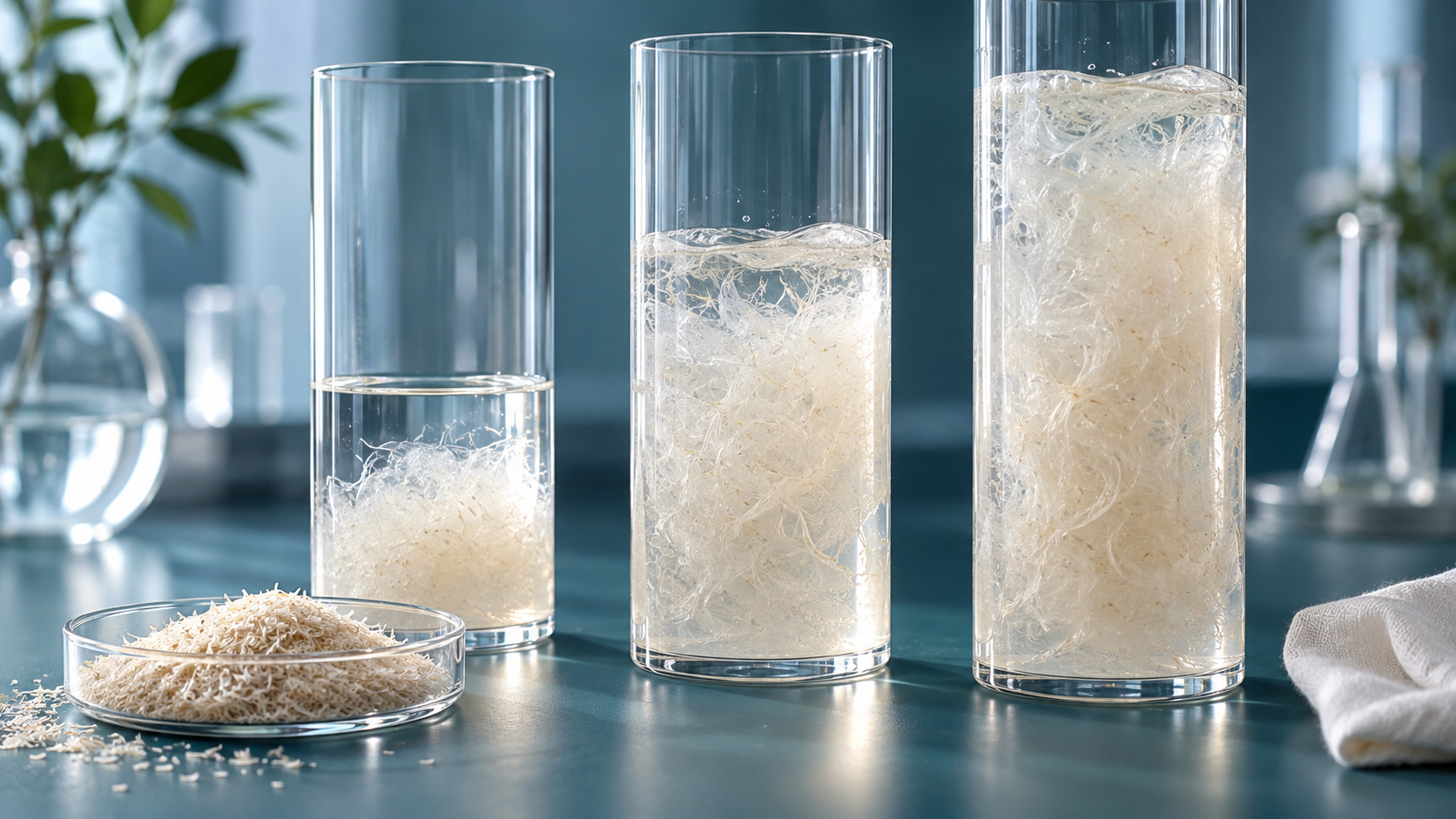
Record the sample mass, whole-husk or powder form, liquid, vessel, temperature, agitation, hydration time and reading procedure. Without aligned conditions, different reported values may not be directly comparable. Do not assume that swelling volume, swelling index, viscosity and water-holding capacity are interchangeable tests.
If a buyer requests a higher commercial target, such as 50 mL/g, record it as a proposed acceptance requirement and confirm feasibility for the selected grade. It is not an automatic property of every high-purity lot. Evaluate dispersion, texture and processing behaviour in the actual formulation separately.
Review the COA and commercial lot
- Match botanical identity, product form, purity definition and mesh where applicable.
- Match the supplier, batch number, sample description and report dates to the proposed material.
- Check actual numerical results, units, methods and reporting basis against agreed limits.
- Distinguish a typical specification or historical report from evidence for the sales lot.
- Review microbiological and contaminant requirements independently of physical and functional tests.
- Resolve missing results or inconsistent methods before accepting the lot.
Build the RFQ before comparing prices
Send the required form, purity definition, mesh, moisture and ash limits, swelling method and target, quantity, destination, application and packaging. Add the required safety tests, documents, sampling arrangements and evidence needed before quotation or shipment. Ask whether additional testing is included in the price, its turnaround time and who pays.
For general analytical background, WHO's Quality control methods for herbal materials is listed as further reading. It does not replace the applicable product standard or the method agreed for a commercial lot.
Discuss your specification with Systler
Systler can review the sourcing requirement against the proposed supply. Confirm grade availability, analytical evidence, testing costs and lead time before commercial commitment. The figures in this guide are not a batch COA or a guarantee for untested material.
Key takeaways
- Each quality parameter measures a different characteristic; read the complete specification.
- Check whether ash results and acceptance limits use a dry basis.
- Define the method behind commercial 95%, 98% and 99% purity descriptions.
- Compare swelling results only under aligned test conditions.
- Use the cited FSSAI criteria within their stated scope and verify current applicability.
- Obtain evidence for the agreed commercial lot and assess safety tests separately.
References & sources
- Psyllium husk purity criteria — FSSAI 2022 document, printed page 76 — Food Safety and Standards Authority of India · View source
- Quality control methods for herbal materials — World Health Organization · View source