Swelling volume describes hydrated psyllium volume relative to sample mass under a defined test, commonly in ml/g. Compare results only with the product form, method and buyer requirement understood. The cited FSSAI document lists 40 ml/g for psyllium husk in its scope; it is not a universal export specification or a guarantee of application performance.
What swelling volume means
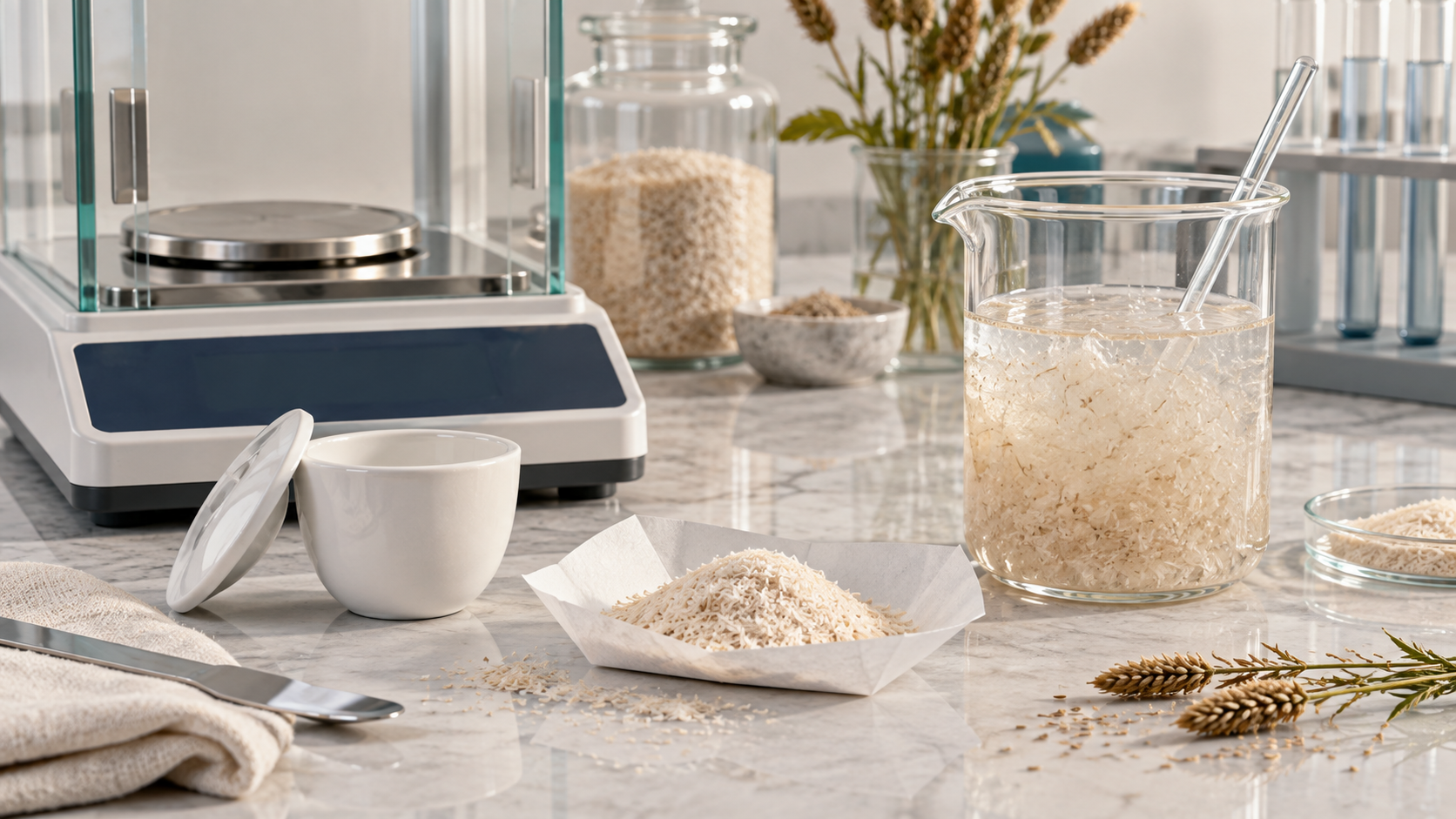
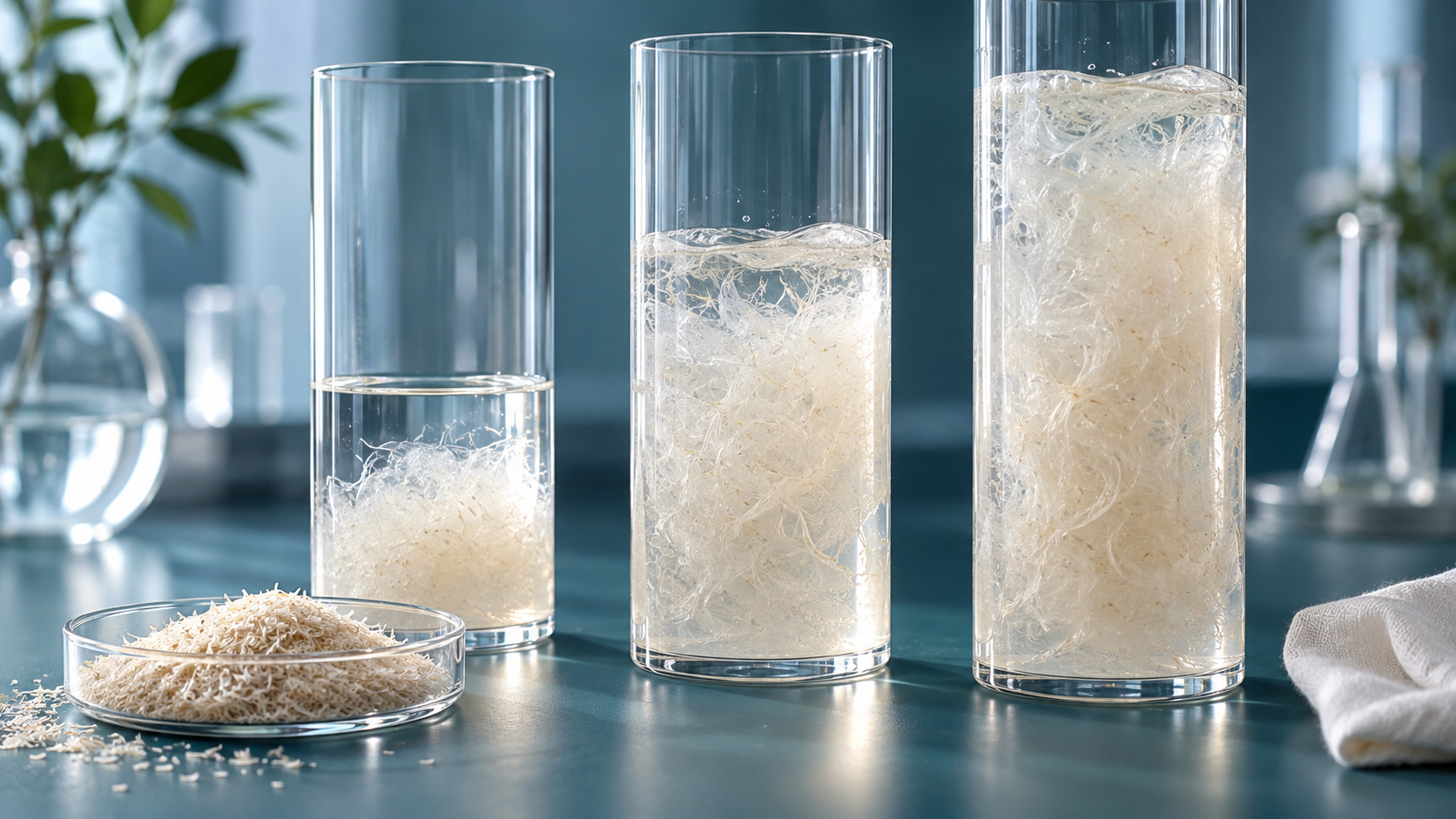
Swelling volume describes the volume occupied by hydrated psyllium under a defined laboratory procedure, expressed relative to the mass tested, commonly in millilitres per gram (ml/g). It is a useful functional quality parameter when the product form, method and reporting basis are clear. A number copied from a quotation without that context is not a complete specification.
For bulk buyers, the practical question is not simply “Which supplier offers the highest number?” It is “Will the offered material meet our agreed requirement, using a comparable test, and perform in our intended process?”
WHO’s Quality control methods for herbal materials, chapter 14, describes swelling index under specified conditions. This provides general method context; the agreed procedure must be appropriate for the actual material.
1. Read the number with its method
A result such as 45 ml/g should be read as a laboratory result under the stated conditions. It is not a recommended amount of water for a recipe, a measure of dietary fibre percentage, or a guarantee of finished-product performance. Ask the laboratory how its method defines the measured volume and reports it relative to sample mass.
| Information to request | Reason for the request |
|---|---|
| Product identity and form | Confirm that the result covers the offered husk or powder, not a different material. |
| Method name, reference and version | Establish what procedure was used and whether both suppliers used the same basis. |
| Sample preparation and mass | Clarify whether the sample was milled, conditioned or otherwise prepared before testing. |
| Liquid and test conditions | Record the liquid, temperature and other conditions prescribed by the method. |
| Mixing, standing time and endpoint | Confirm when and how the final reading was taken. |
| Result, unit and reporting basis | Check that the reported figure can be compared with the buyer requirement. |
| Replicates and acceptance rule | Agree how repeated measurements, rounding and borderline results will be handled. |
This is a list of questions for the laboratory, not a replacement test procedure. Use the agreed method rather than creating a home-made test from the checklist.
2. Understand the 40 ml/g reference
The FSSAI document dated 30 March 2022 lists psyllium (isabgol) husk purity criteria on printed page 76, including a swell volume of not less than 40 ml/gram. That is a reference within the Indian document and its scope, not a universal export specification for every psyllium form and finished product. Before using it for a compliance decision, confirm the applicable current rules, product classification and destination requirements. See the FSSAI source.
A buyer can specify a different contractual target where justified by the intended application. Keep the source of the requirement clear: a cited regulatory criterion, a named standard, or an agreed buyer specification. Do not describe a buyer target as a legal minimum.
3. Separate swelling from other quality measures
| Parameter | What to specify separately |
|---|---|
| Swelling volume | The required minimum, unit and laboratory method. |
| Commercial purity | The meaning of the stated percentage and the assessment basis. |
| Particle size | Whole husk or powder; sieve standard and pass criterion where required. |
| Viscosity or finished texture | The relevant application test and its conditions, if this is a buying criterion. |
| Moisture, ash and safety tests | The agreed limits, methods and lot evidence for each requirement. |
Do not infer a swelling result from a 95%, 98% or 99% commercial purity description. Likewise, a mesh number is not a swelling specification, and a satisfactory swelling result does not establish microbiological or contaminant compliance. See the guide to psyllium quality parameters.
4. Compare supplier offers on the same basis
Before ranking two quotations, ask both suppliers to state the offered product form, commercial purity, particle-size requirement, swelling target and method. Distinguish a typical specification-sheet value from a result obtained for a named lot.
Illustrative values only: the following examples explain purchasing decisions. They are not Systler test results, guaranteed specifications or additional regulatory limits.
| Situation | Interpretation | Next step |
|---|---|---|
| Buyer requires at least 50 ml/g; offered lot reports 45 ml/g using the agreed method | The reported value is below the buyer target, even if the supplier accepts it against a different limit. | Resolve the mismatch before accepting the lot. |
| Supplier A reports 45 ml/g; supplier B reports 50 ml/g but gives no method | The higher figure alone is insufficient for a defensible comparison. | Obtain the methods and reporting basis before ranking the offers. |
| A previous batch reports 52 ml/g; the new sales lot is untested | The old result supports historical assessment, not verification of the new batch. | Agree when the actual-lot result must be available. |
| A sample meets the laboratory requirement but fails the buyer’s mixing trial | The laboratory parameter and application acceptance are different requirements. | Review the trial conditions and specification before ordering. |
5. Check the COA and lot connection
Confirm the batch number, product description, result, unit, limit and method on the certificate of analysis. If a separate report is used, check its sample identification against the offered lot. A brochure claim such as “high swelling” is not a numerical result, and an offer to perform testing later is not evidence that testing has already been completed.
Where the buyer requires sales-lot confirmation before dispatch, record that requirement explicitly. A representative sample may be useful for qualification, but the commercial acceptance decision should use the agreed evidence for the material supplied. See how to read a psyllium COA.
6. Validate the intended application
Use a documented trial to decide whether the selected material works in the buyer’s formulation. Record the ingredient form, use level, water addition, mixing sequence, equipment settings, processing time and evaluation criteria. Keep those conditions consistent when comparing samples.
For a beverage or dry-mix project, define the buyer’s dispersion and texture expectations. For a bakery or binder application, define the relevant processing and finished-product checks. Treat these as application acceptance criteria alongside the laboratory specification. Do not promise that a higher swelling figure alone will solve mixing, texture or processing problems.
7. Put a complete requirement in the RFQ
- Botanical identity, whole husk or powder, commercial purity and particle size where relevant.
- Swelling-volume minimum in ml/g and the agreed test method or a request for the supplier to propose its method.
- Intended application and any sample-trial acceptance criteria.
- Representative COA needed for qualification and actual-lot evidence needed for commercial release.
- Quantity, packaging, destination, commercial basis and delivery window.
- Whether testing is included in the price; any additional charges, sample needs and lead time.
Example RFQ wording: “Please quote the specified psyllium form and grade, with a minimum swelling volume of [buyer target] ml/g using [agreed method and version]. Provide a representative COA identifying the method. Confirm whether the actual sales lot will be tested, when its result will be available, and whether testing is included in the quoted price.”
Complete the placeholders before issuing the enquiry. Use the bulk psyllium RFQ checklist for the remaining quality and commercial requirements.
Frequently asked questions
Is 50 ml/g always better than 40 ml/g?
A higher result does not by itself establish better overall suitability. Check comparable methods, the required minimum, the remaining quality parameters and the application trial.
Are swelling volume and swelling index interchangeable?
Terminology can vary between documents. Confirm the definition and procedure before treating two values as equivalent; matching units alone is not enough.
Can whole husk and powder be compared directly?
Only compare against a clearly defined method and product requirement. Ask whether sample preparation differs and keep the intended commercial form explicit.
Does the test replace an application trial or safety testing?
No. Keep the functional laboratory requirement, formulation acceptance and safety specifications separate.
What if the supplier cannot provide the method?
Keep the comparison unresolved and request clarification or an agreed laboratory test before relying on the value for acceptance.
Discuss the requirement with Systler
Share the required form, commercial purity, mesh where relevant, swelling target, test method, quantity and destination. Documentation availability, lot suitability and any additional testing should be confirmed for the specific enquiry.
Key takeaways
- Specify the swelling minimum together with its unit and test method.
- Keep regulatory references distinct from contractual buyer targets.
- Purity, mesh, viscosity and swelling are separate requirements.
- Compare like-for-like methods and verify the actual sales lot when required.
- Use application trials and the remaining safety tests alongside swelling results.
References & sources
- FSSAI direction dated 30 March 2022: psyllium husk purity criteria, printed page 76 — FSSAI · View source