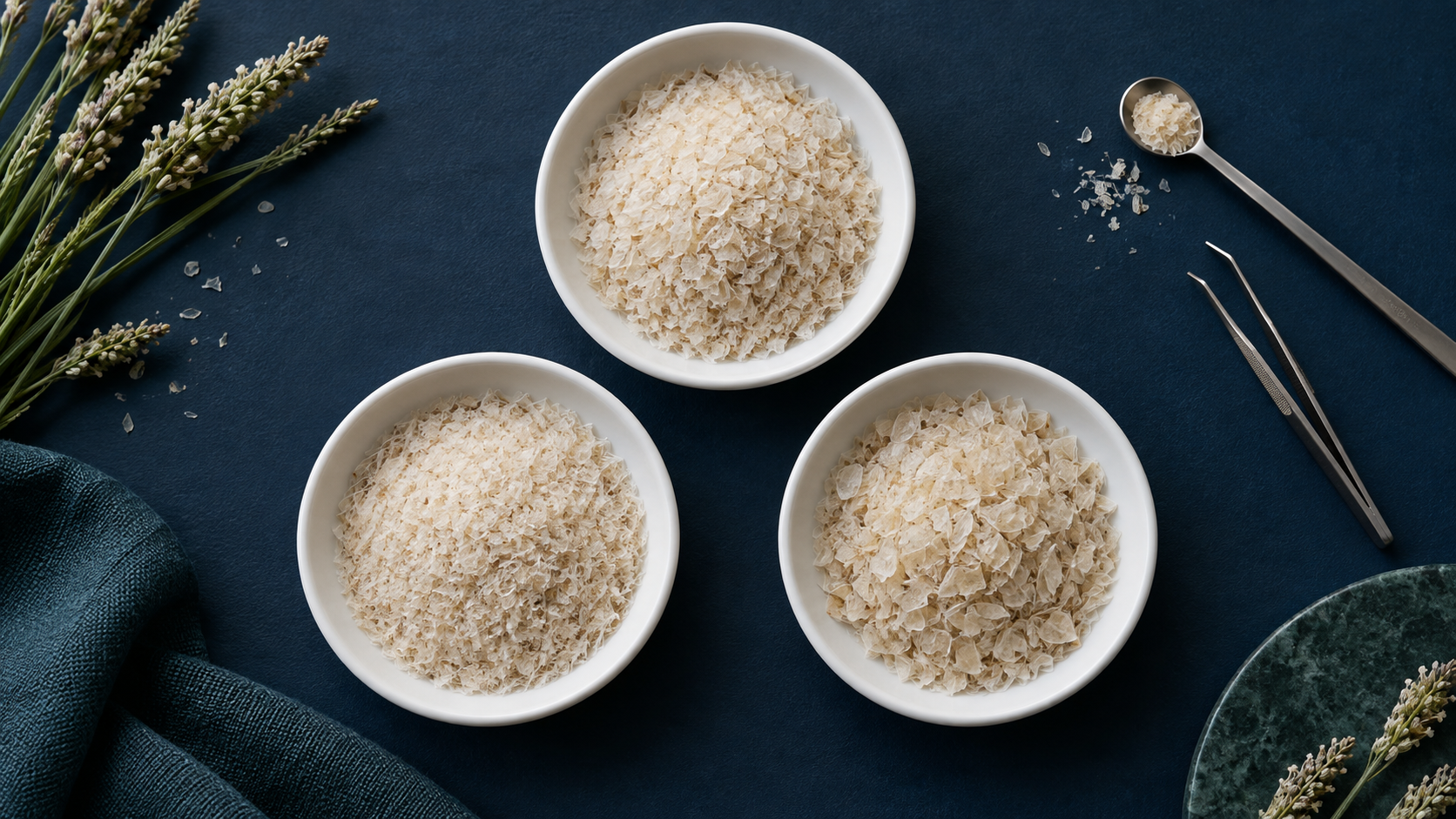
Mesh describes particle-size classification, not purity or overall quality. Compare 40, 60, 80 and 100 mesh offers only after confirming the sieve standard, nominal aperture and percentage passing. Choose against the intended process and sample trial; the highest mesh number is not automatically the best choice.
What does mesh tell a buyer?
A psyllium powder quotation may describe the material as 40, 60, 80 or 100 mesh. These are starting descriptions of particle size. They do not establish commercial purity, swelling performance, contaminant results or suitability for a finished product.
In a common mesh-count convention, a higher count generally corresponds to a finer sieve. Different documents can use different numbering conventions, however. Ask for the standard and nominal aperture rather than interpreting the number in isolation.
1. Define the sieve requirement
WHO’s Quality control methods for herbal materials, chapter 2, describes fineness using sieve apertures in micrometres and defined passing criteria. Its aperture-based sieve numbers should not be confused with commercial mesh counts.
| Commercial description | Clarification to request |
|---|---|
| 40 mesh | Which sieve standard and aperture, and what percentage passing? |
| 60 mesh | Is this a minimum passing requirement or part of a size range? |
| 80 mesh | Are oversize and fine fractions controlled where the application requires this? |
| 100 mesh | Is the method and acceptance rule comparable with the other offers? |
This table does not assign universal micron equivalents. Use the actual sieve standard for any conversion. A generic chart may assume a different convention.
2. Distinguish passing percentage from distribution
A passing criterion describes the fraction meeting a particular sieve condition. It does not necessarily describe how the remaining particles are distributed. Request additional oversize or fines limits, or a particle-size distribution with its method, when these affect acceptance.
Illustrative example: at least 95% passing an agreed sieve is different from 100% passing. A label saying only “80 mesh” does not tell the buyer which was offered. These are examples, not universal psyllium specifications.
3. Keep the other requirements separate
- Commercial purity and its definition.
- Swelling-volume minimum and method.
- Moisture and ash limits.
- Required microbiological and contaminant tests.
- Appearance, treatment restrictions and certification requirements.
- Packaging and destination requirements.
Do not infer a swelling or safety-test result from mesh. Review the separate quality parameters.
4. Design a useful application trial
| Project | Trial questions |
|---|---|
| Drink or reconstitution powder | Does it meet the required dispersion, lumping, texture and holding-time criteria? |
| Bakery or dry blend | Does it meet blend, processing and finished-texture requirements? |
| Filling process | Is it suitable for the actual equipment and finished-product specification? |
| Binder formulation | Does it meet the defined process and product-performance criteria? |
These are questions to test, not promised outcomes for particular mesh numbers. Record sample identity, use level, mixing sequence, equipment, liquid conditions and assessment times. Change one variable at a time where practical. A finer description alone does not guarantee easier dispersion.
5. Link samples to commercial supply
Ask whether the sample represents the offered production specification. Retain its batch reference and trial record. Agree how the supplied lot will be checked and when its COA or particle-size report is due. A previous-lot result does not verify a future batch.
6. Write a clear RFQ
Example wording: “Psyllium husk powder, [purity and basis], with at least [percentage] passing [aperture and sieve standard]. Confirm method and any proposed oversize/fines limits. Application: [use]. Provide representative documentation and confirm sales-lot reporting, quantity, packing and destination pricing.”
Complete the placeholders before ordering. If no size has been selected, request clearly identified trial options with complete specifications rather than asking for the “best mesh”.
Frequently asked questions
Is 100 mesh always better than 40 mesh?
No. Choose against the application trial, full specification and commercial requirement.
Does mesh indicate purity?
No. Specify particle size and purity on separate lines.
Can two 80-mesh quotations be compared directly?
Only after checking the sieve convention, passing criterion, method and remaining product requirements.
Prepare the enquiry
Share application, preferred size or trial options, purity, quantity, destination and tests using the RFQ checklist. Confirm documentation, availability and additional testing for the specific enquiry.
Key takeaways
- Specify mesh and purity separately.
- State the sieve standard, aperture and passing percentage.
- A mesh label does not describe the complete particle-size distribution.
- Compare samples under the same application conditions.
- Agree commercial-lot evidence and testing costs before ordering.
References & sources
- a